

client: Prof. Douglas Hanahan, ISREC - Swiss Institute for Experimental Cancer Research, EPFL
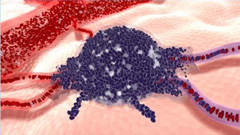
This video describes one of the many approaches of translational cancer research that is being performed at ISREC. It also describes the main hallmarks of cancer and shows a hypothetical drug delivery process, by encapsulating the pharmcological payload in a nano bot.
| watch movie: |  |
client: Crisalix - Virtual Aesthetics
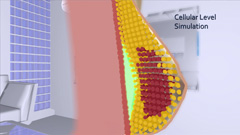
This is a promotional and educational video describing state-of-the-art 3D breast augmentation simulation technology. Crisalix created the first web-based 3D preview technology for plastic surgery, based on the personalized physical properties of the body. Due to its unique solution available on the Web, Crisalix offers practitioners new consultation standards.
| watch movie: | |
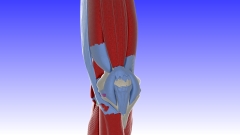
client: Dr. Stéphane Tercier, Département Médico-Chirurgical de Pédiatrie, DMCP, CHUV
This video describes the anatomy of the knee and highlights the individual elements allowing it to bend. A set of animations and images about the knee was created for the purpose of being integrated in a documentary about orthopedy for Centre Hospitalier Universitaire Vaudois (CHUV) in Lausanne, Switzerland.
| watch movie: | |
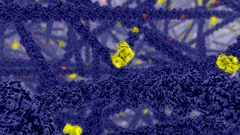
client: Prof. Heinz Koeppl, Biomolecular Signaling and Control, BISON Group, ETHZ
This video shows the visualization of the simulated signal transduction process inside the cell. It focuses on individual molecules and molecular crowding as well as the global view of the cell. The simulation model has been created by the BISON Group at the Swiss Federal Institute of Technology in Zurich (ETHZ).
| watch movie: | |
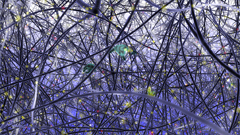
client: Prof. Patrick C. Fraering, Laboratory of Molecular & Cellular Biology of Alzheimer's Disease, EPFL
This movie describes the development of Alzheimer's disease at a molecular level. It shows the very important role of the amyloid-beta peptides in the generation of deadly plaques in the brain. It is proposed by the research of professor Patrick C. Fraering who is head of the laboratory of Molecular and Cellular Biology of Alzheimer's Disease at the Life Science department and Brain Mind Institute of the Swiss Federal Institute of Technology in Lausanne - EPFL.
| watch movie: | |
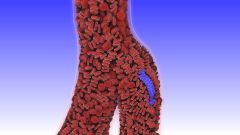
client: Prof. Efthimios Kaxiras and Dr. Simone Melchionna, Laboratory for Multiscale Modeling of Materials, EPFL
This movie shows how medical doctors could use simulations to predict and prevent heart disesases. Hemodynamics is the study of blood flows in the human body. The simulations are based on research done at EPFL, Harvard University, Harvard Medical School and the National Research Council of Italy.
| watch movie: | |
client: Prof. Christian Doerig, Joint Research Unit INSERM-EPFL, Global Health Institute, EPFL
Malaria parasites spread in the hosts blood by means of a fascinating and complex machinery of division. A way to stop the spread of the malaria parasites is hypothesized at a molecular level.
| watch movie: | |
client: Prof. Andrea Volterra, Department of Cell Biology and Morphology, University of Lausanne
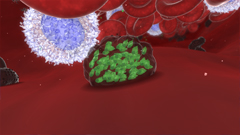
Astrocytes have a central role in the management of neuron signals. The signalling is based on glutamate transmissions between astrocytes and neuronal synapses. It is shown the importance of the cytokine TNFalpha in this exchange. The research was done at the University of Lausanne.
| watch movie: | |
client: Prof. Stewart Cole, Laboratory of Microbial Pathogenesis, Global Health Institute, EPFL
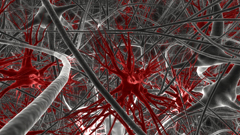
BTZ is a novel drug jointly discovered by the Global Health Institute at EPFL that kills Tuberculosis bacteria. It attacks the building process of the cell walls of these very drug resistant bacteria.
| watch preview: | |
client: Prof. Henry Markram, Blue Brain Project, Brain Mind Institute, EPFL
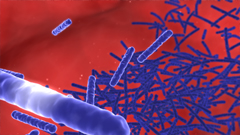
This video shows a section of a rat brain reconstructed as a computer model. The red cell is highlighted to better show the relations of cells through dendritic connections.
| watch movie: | |
client: Prof. Nicola Harris, Laboratory of Intestinal Immunology, Global Health Institute, EPFL
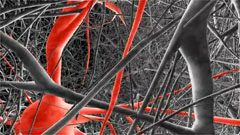
Hookworms are common intestinal parasites that live by eating the red blood cells of their hosts. This animations shows a hypothesis on how the immune system fights hookworms.
| watch preview: | |
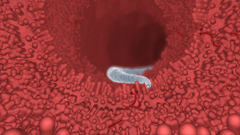
client: Prof. Didier Trono, Laboratory of Virology and Genetics, Global Health Institute, EPFL
HIV propagates from one immune cell to another by a grabbing and "hugging" process also called a dendritic one. This clip shows how the genetic material is transferred on the surface of the cell to the other.
| watch preview: | |
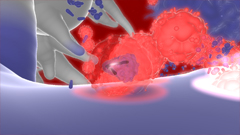
client: Prof. Gisou van der Goot, Van der Goot Lab, Global Health Institute, EPFL
Anthrax is a deadly disease spread by very large molecular toxins. This animation shows how the anthrax toxin penetrates and enters a cell through the cell wall.
| watch preview: | |
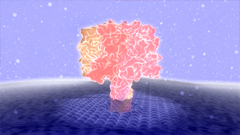
client: Prof. Melanie Blokesch, Laboratory of Molecular Microbiology, Global Health Institute, EPFL
This clip animation shows the Vibrio cholere suspended in water. They are responsible for the Cholera disease.
| No preview available |